
1941 Wheat Penny Value: Reading the Coin Beyond the Obvious
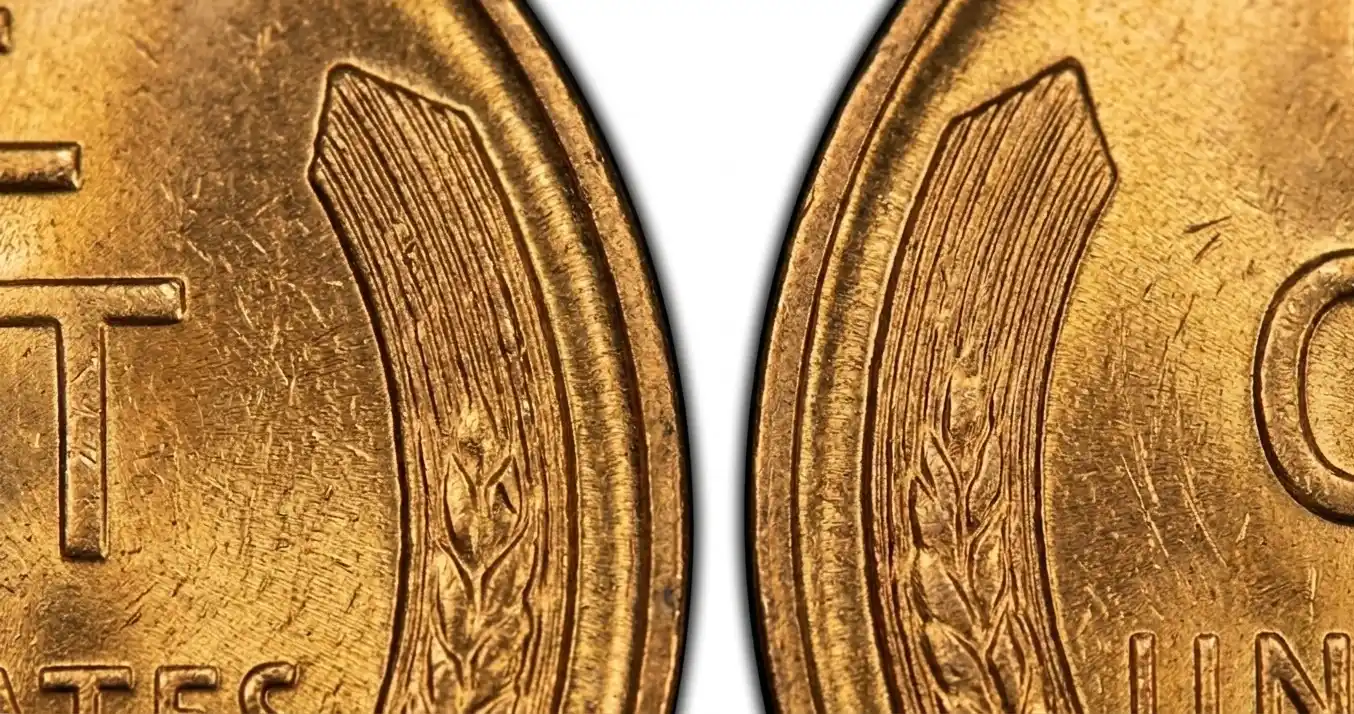
Collectors rarely judge a wheat penny by its date alone—context and condition quietly redefine the 1941 Wheat Penny value.
Production in 1941 represents a massive volume of material categorized by striking quality and metal preservation.
Attribute | Technical Standard |
Mass | 3.11 grams |
Metal Content | 95% Copper, 5% Tin, and Zinc |
Diameter | 19.05 mm |
Edge Type | Plain |
Original Designer | Victor David Brenner |
Production Dynamics and Geographic Origin
Output exceeding one billion units provided the American economy with small change during the pre-war period.
Distribution across mint branches determines the baseline scarcity for each group.
Philadelphia → No mark below the date → 887,018,000 units
Denver → Letter D below the date → 128,700,000 units
San Francisco → Letter S below the date → 92,360,000 units
Geographic origin acts as the primary filter during the analysis of auction listings.
Copper Metal Aging and Color Classification
Natural reactions of the copper alloy lead to gradual changes in the surface appearance.
The 2026 market employs a strict three-tier system for color grading.
Red (RD) — At least 95% original red shine present
Red-Brown (RB) — Original shine ranging between 5% and 95%
Brown (BN) — Total loss of original shine; dark chocolate tones dominate
Moving from RD to RB automatically reduces market appeal by 40–60%.
Brown specimens in 2026 are valued primarily by their face value or raw metal weight.
Professional Grading Scales for 1941 Issues
Certification services divide coins into classes based on microscopic surface damage.
The coin scanner app helps reveal contact marks from other coins or machinery parts.
MS 67+ → Exceptional preservation; zero visible defects at 10x magnification
MS 65 → High-quality strike; minor marks on the fields
MS 63 → Visible factory shine; multiple small scratches
EF 40 → Detailed hair remains; light wear on high design points
VG 8 → Heavy surface erosion; outlines are visible without fine details
Price gaps between adjacent grades at the top of the scale often reach several hundred percent.
Auction Performance and Market Indicators
Actual worth for the 1941 cent in 2026 is confirmed by completed sales data.
Price trends show steady growth for coins in the highest quality categories.
Origin | Condition | Market Price | Sale Platform |
Philadelphia | MS 68 RD | $2,585 | Heritage Auctions |
Denver | MS 68 RD | $3,290 | Stack's Bowers |
San Francisco | MS 67+ RD | $1,800 | GreatCollections |
Annual appreciation for the MS 67 RD grade averages 5.2% compared to data from five years ago.
Market statistics show a 2–3% yearly decline in interest for coins below MS 63 due to oversupply.
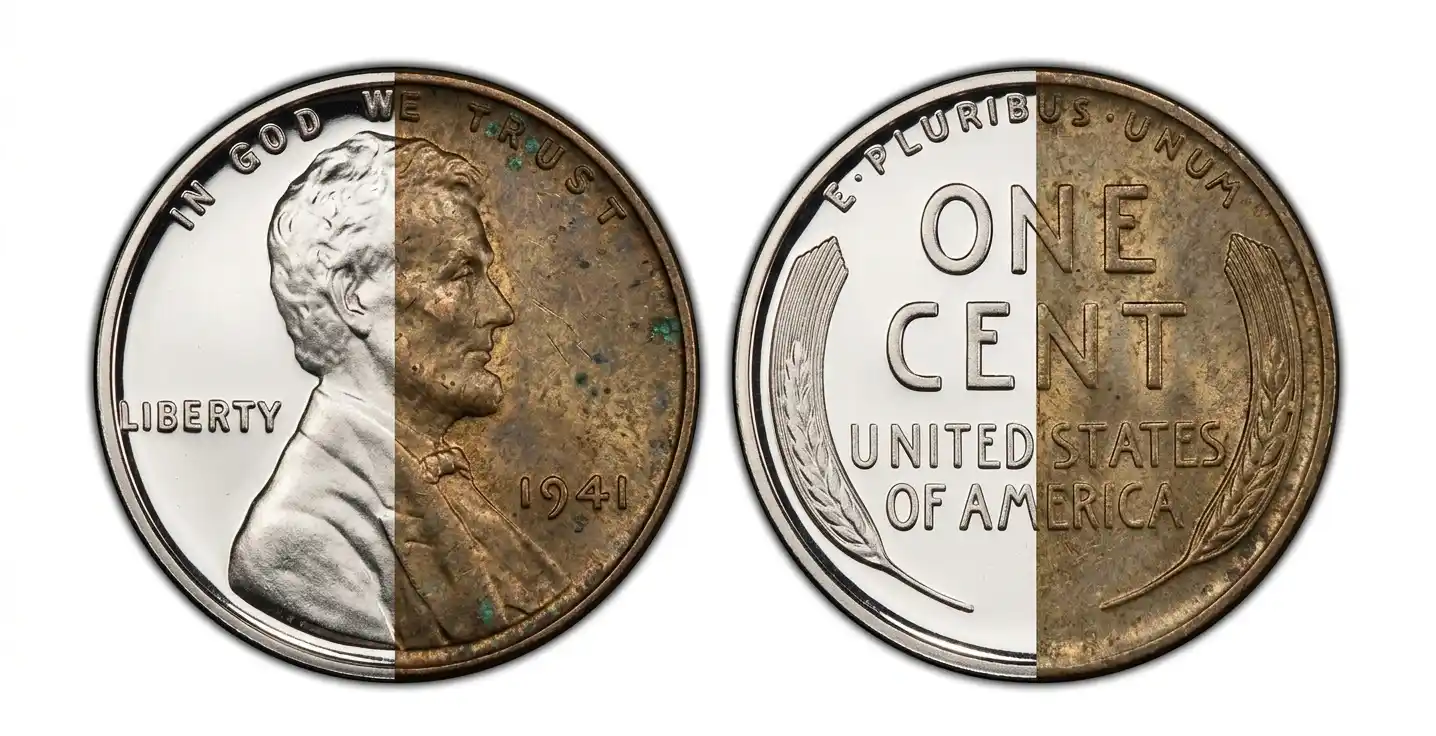
Hidden Production Defects and Die Variations
Small technical deviations create unique added value for 1941 pennies.
Examining the date area and lettering reveals rare stamp variations.
Value creation chain: Equipment wear → Operator error → Doubled elements → Rare variety.
Doubled Die Obverse (DDO) — Strong doubling of the year and the word LIBERTY
Repunched Mint Mark — Second application of the S mark in San Francisco
Die Cracks — Raised lines on the surface caused by fractures in the steel stamp
Confirmed 1941 DDO specimens in MS 65 RD quality reach $1,500 on the current market.
Special Characteristics of Proof Coinage
Only 21,100 coins were struck using special technology for collectors in 1941.
This category avoids mass contact between blanks during the manufacturing process.
Proof identification markers: Mirror fields + Frosted relief → High contrast → Maximum grade.
Market prices for PR 67 RD samples have stabilized at $11,500 in 2026.
Adding a "Cameo" effect increases the coin's value by another 35% due to aesthetic rarity.
2026 Survival Rate Analysis
Professional registries from PCGS and NGC record the number of existing coins in every grade.
Real market supply is limited by the number of certified high-end specimens.
Population breakdown for 1941-D MS 67 RD: Total registered → 184 units Available for sale in 2026 → Less than 15 units monthly Percentage of total mintage → 0.00014%
Such ratios explain the aggressive bidding seen at auctions for top-tier grades.
Long-term Preservation of Copper Assets
Preservation of a 1941 coin depends entirely on the environment of its storage location.
Copper reacts with air and moisture, irreversibly destroying collector potential.
Damage Source → Financial Consequence:
Humidity above 50% → Dark spot formation → 70% price drop
PVC plastic contact → Green residue appearance → Total loss of liquidity
Direct sunlight → Patina fading → 25% value reduction
Sealed plastic holders are mandatory standards for coins valued above $50.
Macroeconomic Impact on Numismatics
Investors in 2026 view 1941 pennies as a tool for diversifying private savings.
Inflation expectations drive interest toward physical assets with verified quality.
Comparing base vs. collector value: Raw copper value → $0.02 MS 67 RD market value → $700.00
This difference confirms that a coin's condition is 35,000 times more important than its metal content.
Growth rates for rare varieties currently beat inflation by 4.8% annually.
Comparative Analysis of Mint Facilities
Each production unit had unique technical nuances affecting the final product in 1941.
Philadelphia produced coins with the sharpest details due to centralized quality control.
Denver shows a higher frequency of field marks caused by the transportation of blanks.
San Francisco used stamps with softer relief, making it harder to find coins with full detail.
Confirmed MS 68 counts:
Philadelphia: 18 units
Denver: 4 units
San Francisco: 0 units (certified)
Data proves the exceptional rarity of the California issue in perfect condition.
Authenticity Verification and Fraud Protection
High demand for rare grades in 2026 leads to attempts at modifying original coins with the free coin identifier app.
Common modification methods: Adding the S letter → Faking a rare mint Mechanical doubling → Faking a DDO variety
Chemical polishing → Faking factory shine
Professional analysis involves using spectral equipment and high-resolution microscopy.
Absence of microscopic flow lines on the coin's field indicates third-party interference.